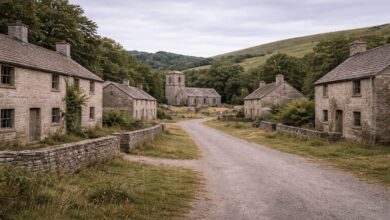
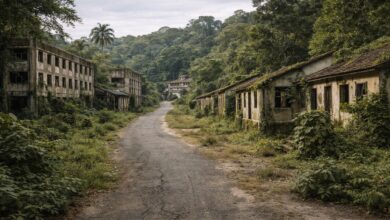
Just a short boat ride from Port Blair in the Andaman and Nicobar Islands, Ross Island lies quietly beneath dense tropical growth. Once the administrative heart of British rule in the Andaman Islands, the island today is uninhabited, its grand buildings reduced to ruins woven through by roots, vines, and salt air. Ross Island is not abandoned due to myth or mystery. It was overtaken by history, environment, and shifting political realities.
The island’s transformation from colonial capital to forested ruin happened in stages. It reflects how power can concentrate in a place, build elaborate systems of control and comfort, and then retreat, leaving structures behind to be reclaimed by climate and time. Ross Island does not unsettle through fear. It unsettles through contrast.
A strategic outpost in the Bay of Bengal
The Andaman Islands occupied a strategic position within the British Empire. Isolated yet reachable, they were seen as ideal for establishing penal colonies and naval oversight in the Bay of Bengal. Ross Island, located close to the natural harbor at Port Blair, became the administrative center of this colonial project in the mid nineteenth century.
From this small island, British authorities governed prisons, settlements, and infrastructure across the archipelago. Decisions that shaped thousands of lives were made here, far from mainland India but firmly embedded within imperial control.
Ross Island was chosen not for resources, but for oversight. Similar human responses to silence and environment appear in Hashima Island.
Building a colonial capital
During its peak in the late nineteenth and early twentieth centuries, Ross Island was developed into a self contained colonial enclave. Residences for officers, administrative buildings, churches, clubs, bakeries, hospitals, and recreational facilities were constructed.
The architecture reflected British tastes transplanted into a tropical setting. Wide verandas, high ceilings, and stone foundations were adapted to heat and humidity. Gardens were carefully maintained. Roads were laid out deliberately.
The island was often described as elegant and orderly, sharply contrasting with the surrounding forest and the harsher conditions of nearby penal settlements.
Life apart from the mainland
Ross Island functioned as a world apart. British officers and their families lived here in relative comfort, insulated from both the local population and the realities of prison labor elsewhere in the islands.
Social life revolved around clubs, church gatherings, and formal events. Supplies arrived by boat. Communication with the mainland was limited but steady.
This separation reinforced hierarchy. Ross Island represented authority, while nearby islands represented confinement and labor.
Environment as constant pressure
Despite its refinement, Ross Island existed within a demanding environment. Tropical weather, monsoon rains, humidity, and seismic instability posed constant challenges.
Buildings required ongoing maintenance. Termites, corrosion, and vegetation worked continuously against stone and wood. The island’s beauty depended on constant intervention.
Nature was never fully subdued. It was managed.
The earthquake that shifted everything
In 1941, a powerful earthquake struck the Andaman region. Ross Island suffered extensive damage. Buildings cracked. Foundations weakened. Infrastructure was compromised.
Though repairs were attempted, the scale of damage combined with wartime pressures made continued occupation impractical. Administrative functions were gradually shifted to Port Blair.
The earthquake marked a turning point. Ross Island ceased to be viable as a colonial capital.
War and transition
During World War Two, the Andaman Islands were occupied by Japanese forces. Ross Island changed hands, further disrupting its administrative role. After the war and India’s eventual independence, the colonial system that had sustained the island no longer existed.
There was no reason to restore Ross Island to its former status. The center of governance had moved. The island was left behind.
Abandonment was not dramatic. It was administrative.
Nature reclaims the ruins
Without human maintenance, Ross Island changed quickly. Tropical vegetation spread across foundations and through walls. Roots forced apart stone. Trees grew where floors once lay.
Unlike arid ruins that preserve outlines clearly, Ross Island’s structures softened into the landscape. Buildings remain recognizable, but they are entwined with living growth.
This process continues. The island is not frozen in decay. It is actively transforming.
Walking through layered absence
Today, visitors encounter roofless buildings, skeletal staircases, and arched doorways opening onto forest. Signs identify former functions: church, hospital, bakery, officers’ quarters.
These labels emphasize absence. The spaces remain, but the systems that animated them are gone.
The silence is not empty. It is filled with wind, insects, and the slow movement of leaves.
A colonial past without spectacle
Ross Island is sometimes framed as eerie, but this interpretation overlooks its historical clarity. There is no unresolved mystery about why it was abandoned.
The island lost relevance when its administrative purpose ended. Environmental damage accelerated that process.
Its ruins are not warnings or omens. They are records.
Memory and responsibility
As a heritage site, Ross Island presents challenges. Preservation efforts focus on stabilizing ruins and managing vegetation without attempting full restoration.
This approach acknowledges complexity. The island represents colonial authority, not neutral history. Preserving it requires context rather than glorification.
Interpretive signs emphasize function and transition rather than nostalgia.
Wildlife and quiet coexistence
Today, Ross Island is home to birds, deer, and marine life. With no permanent human population, ecological processes dominate.
The forest does not erase history. It integrates it.
This coexistence underscores how quickly environments adjust once human systems withdraw.
Why Ross Island endures
Ross Island endures because it shows how power leaves physical traces long after it departs. It demonstrates that abandonment is not always the result of failure or disaster.
Sometimes, places are simply outlived by the systems that created them.
Ross Island did not collapse. It was replaced.
Between empire and ecology
The island sits between two forces. One historical, one natural. Colonial architecture speaks of authority and order. Vegetation speaks of continuity and adaptation.
Neither dominates completely. The island holds both.
This balance makes Ross Island compelling. It is neither pristine nature nor preserved monument.
A place shaped by withdrawal
Ultimately, Ross Island is defined by withdrawal. Of administration. Of population. Of control.
What remains is structure without function and memory without narrative reinforcement.
The island does not explain itself loudly. It allows observation.
A quiet lesson in impermanence
Ross Island reminds visitors that built power depends on maintenance, relevance, and context. When those fade, even the most organized systems dissolve.
Stone yields to roots. Order yields to growth.
This is not destruction. It is transition.
A landscape that remembers differently
Unlike written history, Ross Island records memory through space. Paths that lead nowhere. Walls that frame trees. Foundations that outline absence.
These traces invite reflection rather than interpretation.
The island stands as a reminder that history does not always end with collapse or ceremony. Sometimes, it ends with quiet relocation.
Ross Island remains in the Andaman Sea not as a mystery, but as a calm record of how authority, environment, and time reshape places once considered permanent. Related reflections on memory and perception can also be found in Poveglia Island.
Horizon Report documents places shaped by memory, infrastructure, and human decisions. Our editorial approach focuses on what remains physically visible, how abandonment unfolds over time, and how interpretation is clearly separated from observable evidence.
For readers seeking deeper context, the following background articles explore how ghost towns emerge, why communities are left behind, and why preservation matters in understanding collective history.
- Abandonment And Ghost Towns
- What Is A Ghost Town
- Why Towns Are Abandoned
- Preserving Abandoned Places
Editorial transparency matters. Observations are grounded in site layout, materials, remaining structures, and documented timelines where available. Interpretive layers are presented as interpretation, not assertion.
Careful readers often notice details worth refining. Thoughtful feedback helps ensure accuracy, clarity, and long term editorial integrity.